
777 Fire Strike is a modern online slot-style game inspired by classic casino mechanics but enhanced with dynamic visual effects, multipliers, and progressive reward systems. It is designed for mobile-first users, especially popular in the Indian gaming ecosystem where fast-paced slot gameplay attracts both beginners and experienced players.
The game revolves around spinning reels, matching symbols, and triggering bonus mechanics that simulate a fiery arcade experience. Unlike traditional slot machines, 777 Fire Strike integrates interactive animations and layered reward structures, making each spin feel more engaging and unpredictable.
Players are drawn to its simplicity—spin, wait, and win—but beneath that simplicity lies a structured probability system driven by RNG.
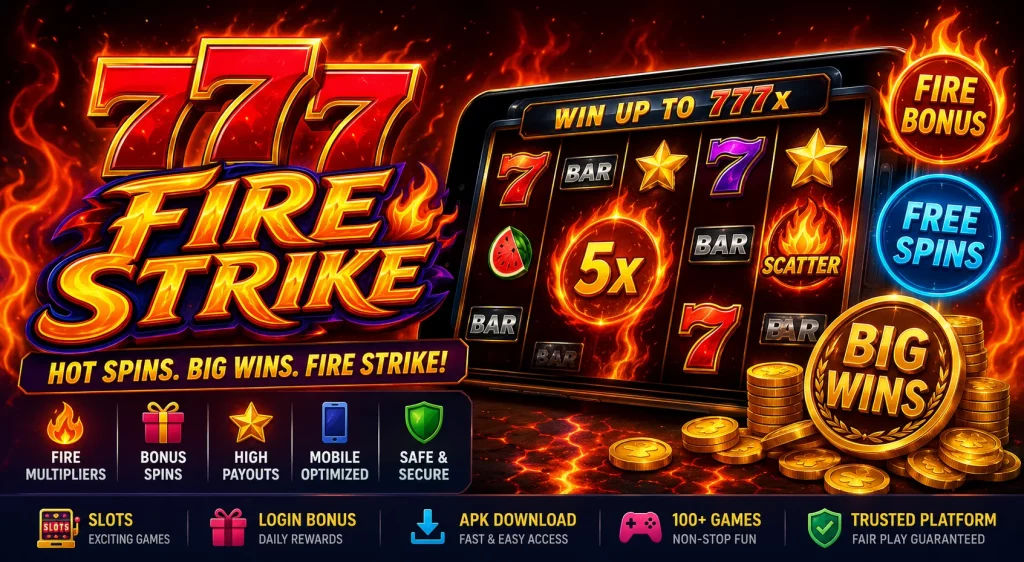
Core Gameplay Mechanics
The gameplay of 777 Fire Strike follows a standard 5-reel structure, but with unique modifiers:
- Fire multipliers that randomly activate
- Wild symbols replacing other icons
- Scatter triggers for bonus rounds
- Free spin cycles with escalating rewards
Every spin is independent, meaning outcomes are not influenced by previous results.
Symbol System Breakdown
| Symbol | Type | Function | Value Impact |
|---|---|---|---|
| 7️⃣7️⃣7️⃣ | Premium | Jackpot Trigger | Very High |
| 🔥 Fire Icon | Multiplier | Boosts Wins | High |
| ⭐ Star | Scatter | Free Spins | Medium |
| 🔔 Bell | Standard | Base Win | Low |
| 🍒 Fruit | Classic | Small Wins | Low |
Game Flow Structure
The structure of a spin cycle is simple:
- Player sets bet
- Reels spin
- Symbols align
- Wins calculated
- Bonus triggered (if available)
The excitement lies in unpredictability and multiplier activation.
Early Player Experience Insight
New players often experience:
- Frequent small wins in early spins
- Gradual introduction to bonus rounds
- Visual “fire burst” effects when wins occur
The design is intended to create engagement loops that keep users spinning longer.
Core Mechanics & Activation Rules
| Feature | How It Activates | Player Effect | Impact Level |
|---|---|---|---|
| Scatter Symbols | Random reel appearance | Triggers free spin mode | Medium |
| Fire Multiplier | Random probability boost event | Increases win value per spin | High |
| Wild Expansion | Special symbol activation | Replaces other symbols | Medium-High |
| Free Spin Mode | 3+ scatter triggers | No-cost extended play | Very High |
Understanding RTP in 777 Fire Strike
In every slot-based system like 777 Fire Strike, the concept of Return to Player (RTP) is one of the most important mathematical foundations behind gameplay behavior. RTP is not something a player “feels” in the moment; instead, it is a long-term statistical expectation that defines how much value is returned to players across thousands or even millions of spins.
In simple terms, if a game has an RTP of 96%, it means that over a very large number of bets, the system is designed to return 96 units for every 100 wagered. The remaining 4% represents the built-in platform margin.
RTP=Total BetsTotal Returns×100
What makes 777 Fire Strike interesting is not just the RTP number itself, but how it is distributed across gameplay events. Instead of being evenly returned, rewards are clustered into moments—small wins appear frequently, while larger payouts are stored in rare high-volatility bursts such as fire multipliers or bonus triggers.
This creates a psychological illusion of momentum, even though mathematically each spin remains independent.
How Bonus Systems Actually Shape Gameplay
The bonus structure in 777 Fire Strike is where the game truly differentiates itself from traditional static slot machines. Instead of relying only on base reel combinations, the system introduces layered reward mechanics that activate under specific probability conditions.
At the core, there are four major hidden layers working simultaneously:
The first layer is the base reel system, which generates standard symbol combinations. This is the most stable and predictable part of the game, responsible for frequent but smaller wins. It forms the “background rhythm” of gameplay.
The second layer is the scatter-driven activation layer, where special symbols begin to influence the state of the game. When scatter symbols appear in sufficient quantity, the system transitions into a bonus state. This is not guaranteed by timing but purely by probability thresholds embedded in the RNG model.
The third layer is the fire multiplier engine, which is one of the defining features of this game. Instead of increasing winnings linearly, it applies random multipliers that can significantly amplify results in a single spin cycle. This is where volatility spikes become noticeable.
The fourth layer is the free spin recursion system, which extends gameplay without requiring additional bets. During this phase, multipliers and wild expansions often stack together, producing the highest potential payout scenarios.
Bonus Behavior in Real Gameplay Conditions
From a player’s perspective, bonuses in 777 Fire Strike do not appear evenly spaced. Instead, they tend to cluster, which is a natural result of probability distribution patterns in high-volatility systems.
A player might experience a series of spins with minimal or no reward, followed by a sudden activation of a bonus round that dramatically changes the balance of winnings. This contrast between quiet phases and explosive reward phases is intentional in modern slot design, as it increases emotional engagement and retention.
Unlike skill-based games, there is no mechanical way to force or predict bonus activation. However, what players often notice is that longer sessions statistically increase exposure to bonus events simply because more spins equal more probability samples.
Bonus Activation Frequency
Volatility and Emotional Game Design
One of the most important characteristics of 777 Fire Strike is its volatility structure. Volatility refers to how frequently wins occur and how large those wins tend to be.
In low-volatility games, players experience steady but small wins. In contrast, high-volatility systems like this one are designed around unpredictability. Wins may not appear for several spins, but when they do, they tend to be significantly larger.
This structure is not accidental. It is closely tied to engagement psychology. Humans naturally respond more strongly to unexpected rewards than predictable ones. When a bonus finally activates after a quiet sequence, the emotional impact is much stronger than if rewards were constant.
The system therefore balances between patience and anticipation. Players who continue spinning are effectively increasing their exposure to rare high-value events, even though each individual spin remains random.
Reward Cycle Dynamics in Practice
In real gameplay sessions, reward cycles tend to follow a repeating pattern, although not in a strictly predictable way. A typical session may begin with moderate activity, where small wins appear occasionally, giving the player a sense of progression.
After this phase, there is often a “dry interval” where results become sparse. This phase is where many users mistakenly assume the game is becoming less favorable, but statistically, it is simply part of normal variance distribution.
Eventually, a trigger event occurs—often a scatter combination or multiplier activation—which leads into a high-reward sequence. During this short window, most of the significant winnings in a session are generated.
What makes this cycle effective is not consistency, but contrast. The difference between low activity and high reward moments creates a strong perception of excitement.
Economic Structure Behind the Game
From a system design perspective, 777 Fire Strike operates on a controlled balance between player return and platform sustainability. RTP ensures fairness over long timeframes, while volatility ensures that rewards are distributed unevenly enough to maintain excitement.
This balance is what keeps the game both playable and profitable. If rewards were too frequent, the system would lose sustainability. If they were too rare, players would disengage quickly. The design therefore sits in a carefully tuned middle range.
Understanding Player Strategy in 777 Fire Strike
In systems like 777 Fire Strike, “strategy” does not mean controlling outcomes—because every spin is governed by RNG. Instead, strategy is about how players manage time, bankroll, and exposure to volatility cycles.
The most important misconception is that players can predict wins. In reality, no pattern can reliably influence outcomes. What players can influence is how long they stay in the system and how they react to variance phases.
A typical session is not linear. It moves through emotional and statistical phases: calm periods, near-win illusions, and sudden reward spikes. Understanding this structure is what separates random play from optimized play behavior.
Probability Thinking in Simple Terms
Every spin in 777 Fire Strike is an independent event. This means the system does not “remember” previous outcomes. However, humans naturally interpret sequences as patterns, which leads to incorrect assumptions about timing or “due wins.”
Mathematically, each spin can be described as:
P(Win)=Total Possible OutcomesNumber of Winning Outcomes
But in real gameplay, this probability is distributed unevenly across outcomes. Small wins occur more frequently, while large wins are intentionally rare. This is what creates the illusion of “hot” and “cold” cycles.
Behavioral Optimization (How Players Actually Interact)
Instead of focusing on prediction, experienced players focus on control systems:
They limit session duration to avoid emotional overreaction during dry phases. They also manage bet size consistency so that volatility does not drain resources too quickly.
Another important behavioral aspect is reaction to near-misses. The game is designed so that almost-winning combinations appear more often than actual wins. This is not accidental—it is a psychological reinforcement loop that encourages continued engagement.
Understanding this structure helps players recognize that emotional spikes are part of the design, not indicators of future outcomes.
Strategy & Risk Model
| Play Style | Behavior Pattern | Risk Level | Expected Outcome Type |
|---|---|---|---|
| Conservative Cycling | Small consistent bets over time | Low | Stable micro-wins |
| Volatility Hunting | Extended sessions waiting for bonus triggers | Medium | Occasional high spikes |
| Aggressive Burst Play | High bets in short sessions | High | High variance outcomes |
| Session Control Strategy | Fixed time + stop-loss rules | Low | Balanced long-term behavior |
Volatility Flow and Reward Distribution
The most important concept in 777 Fire Strike is volatility flow. This refers to how rewards are distributed over time rather than per spin.
Instead of a steady stream of results, the system generates clustered reward events. This means players may experience long periods of low activity followed by sudden bursts of high-value outcomes.
This structure is mathematically intentional because it balances RTP constraints with engagement design. If rewards were evenly distributed, the game would feel predictable. If they were too rare, players would disengage quickly. The system therefore sits in a carefully tuned volatility corridor.
Volatility Simulation
Interpreting the Graph Behavior
What this visualization shows is not prediction but structure. The low sections represent base gameplay where small wins or neutral outcomes occur. The spikes represent bonus triggers such as multipliers or free spins.
The key insight is that reward intensity is not linear. It behaves in waves, where calm periods are necessary for balancing the high-impact events.
Players who understand this pattern tend to make more rational decisions during low phases instead of reacting emotionally to temporary droughts.
Mobile-First Design in 777 Fire Strike
The modern version of 777 Fire Strike is built primarily for mobile users, which reflects the broader shift in online gaming behavior, especially in India and similar mobile-dominant markets. Instead of being a simple “port” from desktop, the game is engineered from the ground up for touch interaction, short sessions, and fast response loops.
This means every part of the interface is optimized for quick decision-making: spin buttons are large and responsive, animations are lightweight but visually intense, and transitions between states are designed to feel instant. Even when complex bonus logic is happening in the background, the player experience remains smooth and uninterrupted.
A major focus is performance stability. The game must behave consistently across low-end and mid-range devices, which often requires adaptive rendering techniques that reduce visual complexity without changing gameplay logic.
APK Access and Distribution Model
In many regions, including parts of India, players often access games like 777 Fire Strike through APK installations rather than traditional app stores. This distribution method allows faster updates and broader accessibility, especially when regional restrictions or store limitations exist.
However, APK usage also introduces responsibility for the user. Since APK files can come from multiple sources, players must ensure they are using trusted versions to avoid modified builds or unstable releases. Official versions are typically optimized for performance, fairness, and security, while unofficial ones may introduce unpredictable behavior.
From a system perspective, APK distribution allows developers to push updates more frequently, especially for balancing volatility, adjusting RTP ranges, or introducing seasonal bonus events.
Ecosystem Integration with Gaming Platforms
777 Fire Strike is rarely a standalone experience. Instead, it is often integrated into broader gaming ecosystems that include card games, slot variations, and reward-based systems. In such ecosystems, player progression is not limited to a single game but extends across multiple titles.
This creates a unified engagement loop where users can move between different game types while maintaining a consistent profile, balance system, and reward structure. The ecosystem model increases retention because progress feels cumulative rather than isolated.
Players may also encounter cross-promotional mechanics such as shared Login Bonus systems or event-based reward pools that span multiple games within the same platform.
User Journey Flow in Mobile Environment
A typical user journey in 777 Fire Strike begins with entry through a home lobby or game selection screen. From there, the player launches the slot interface and immediately enters a spin-based loop.
The experience is intentionally frictionless: minimal loading time, instant gameplay access, and continuous reward feedback. When bonuses trigger, transitions are seamless rather than disruptive, which keeps engagement levels high.
Over time, players begin to recognize their own behavioral patterns—how long they usually stay in sessions, when they tend to stop, and how often they encounter bonus events. This self-awareness often influences how they approach future sessions.
Device Performance Distribution
| Device Category | Performance Level | Visual Quality | Stability | User Experience Notes |
|---|---|---|---|---|
| High-End Smartphones | Excellent | Ultra smooth animations | Very stable | Best experience with full visual effects and fast transitions |
| Mid-Range Devices | Good | Slightly reduced effects | Stable | Balanced performance with minor animation optimization |
| Low-End Devices | Moderate | Basic visuals only | Occasional lag possible | Gameplay remains functional but visual effects are simplified |
| Older Android Versions | Limited | Minimal effects | Variable stability | Performance depends heavily on system resources and background load |
Platform Economy and Player Engagement Systems
Beyond gameplay itself, 777 Fire Strike operates within a larger engagement economy. This includes reward cycles, progression incentives, and system-driven retention mechanics.
Players are often encouraged to return through structured incentives such as daily rewards, streak-based bonuses, and time-limited events. These systems are not random; they are carefully scheduled engagement triggers designed to maintain user activity over time.
Within this ecosystem, progression is not purely based on wins or losses but on continuous participation. Even small interactions contribute to long-term engagement scoring.
777 Fire Strike is not just a slot-style game; it is a structured engagement system built around volatility, mobile optimization, and behavioral design. Its strength comes from combining:
- Fast mobile performance
- Layered bonus mechanics
- APK-based accessibility
- Cross-platform ecosystem integration
Together, these elements create a loop where gameplay, reward psychology, and platform design reinforce each other.
777 Fire Strike — FAQ (Extended Answers)
1. What is 777 Fire Strike?
777 Fire Strike is a modern slot-style game built around spinning reels, symbol combinations, and layered bonus systems. It includes multipliers, wild expansions, and free spin mechanics. The gameplay is designed for fast mobile interaction, where each spin is independent and driven by RNG (Random Number Generation), ensuring unpredictable outcomes.
2. Is the game skill-based or random?
The game is fully random. Every spin is generated independently using RNG systems. This means there is no memory of previous spins and no skill-based manipulation of outcomes. However, players may observe variance cycles such as streaks or dry phases due to probability distribution, not actual patterns.
3. How does RTP work in 777 Fire Strike?
RTP (Return to Player) is a statistical measure showing long-term payout percentage. It does not guarantee short-term results. Instead, it describes how the system behaves over a large number of spins.
4. What are bonus features?
Bonus features include free spins, scatter triggers, wild expansions, and multiplier events. These mechanics temporarily change the gameplay state and increase winning potential. They are triggered randomly or through specific symbol combinations.
5. Why do wins feel uneven or clustered?
This happens due to volatility-based design. Instead of steady payouts, the game distributes rewards in phases. Players may experience long low-activity periods followed by sudden bonus bursts. This structure is intentional and based on probability distribution, not timing patterns.
6. Can bonus events be predicted?
No, bonus events cannot be predicted. They are triggered by random probability conditions within the RNG system. Longer sessions only increase exposure to events but do not influence timing or guarantees.
7. What devices work best?
High-end smartphones provide the smoothest experience with full animations. Mid-range devices still perform well with slight optimization. Low-end devices may reduce visual effects but keep core gameplay functional.
8. Is APK installation safe?
APK installation is safe only when downloaded from trusted sources. Unofficial versions may contain modified code or unstable performance. Official builds are always recommended for security and stability.
9. Why do small wins happen more often than big wins?
This is due to volatility balancing. Small wins are frequent to maintain engagement, while large wins are rare and tied to bonus systems. This structure ensures long-term balance between excitement and sustainability.
10. Does longer play increase winning chances?
Longer play does not change probability per spin, but increases total exposure to random events. More spins mean more chances to encounter bonus triggers, but outcomes remain fully random and independent.






Comments